
Research
Lipid bilayers and proteins embedded into these membranes are central to cellular regulation and communication processes. Generating bio-inspired synthetic nano-compartments and membrane systems would pave the way to novel, biocompatible materials and biosensors. So far, most efforts into this direction have focussed on membrane engineering (synthetic cells, drug delivery nanoparticles, etc...). We are interested in designing new proteins with tailored properties to functionalize these membranes. Because of experimental challenges associated with membrane proteins, many biophysical aspects of protein folding into lipid membranes are still poorly understood. We use bottom-up protein design (de novo) and high-throughput folding assays to test new hypothesis and learn about the biophysics of membrane protein folding.

Understanding principle to design membrane proteins
We are interested in transmembrane β-barrels (TMBs), a class of integral membrane proteins forming a stable pore from a single β-sheet curving to close on itself. In vivo, they play a critical role in the function and homeostasis of the outer membrane of Gram negative bacteria. TMBs are also extensively used in industry for in vitro applications such as nanopore sequencing. The computational design of TMBs remains challenging because of poor understanding of fundamental biophysics of folding and stability. We aim to address these shortcomings by applying a high-throughput design/test strategy to study global and local sequence determinants of TMB folding, beyond the classic single-mutation approach. To do so, we develop new de novo design methods and experimental screening assays in biological and synthetic membranes, leveraging fast advances in High Performance Computing, DNA synthesis and sequencing.
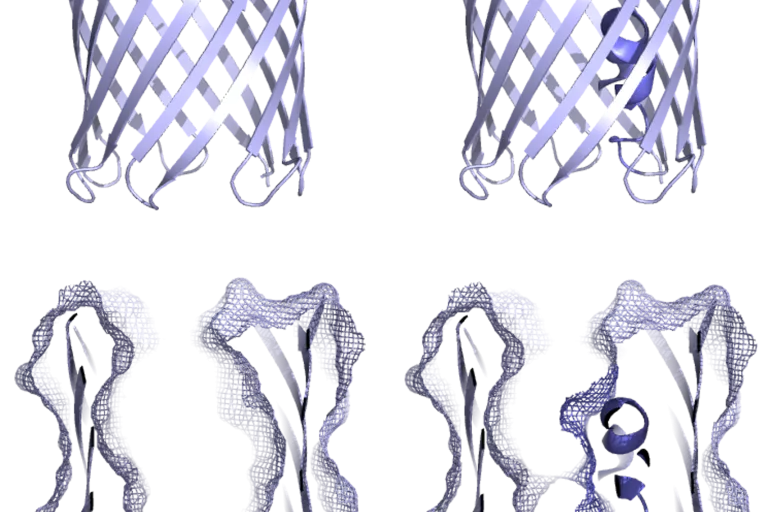
De novo design of nanopores with controlled shape and properties

Designing transmembrane fluorescent proteins
In eukaryotic cells, TMBs fold in the outer membrane of mitochondria, which is a cross-road for cellular signalling pathways and apoptosis. We design TMBs that specifically binds cell-permeable, non-toxic fluorescent dyes and engineer them into modular synthetic biology tools to interact with native components of the mitochondrial outer membrane and to study related biological processes by super-resolution microscopy.